The full framework
Model for Adaptive Response to Complex Cyclical Disasters
MARCCD
Phases of Disaster
Chronic, cyclical disasters push a community through exhausting, recurring phases of anticipation, impact, and adaptation before a final recovery phase can begin
- We can more accurately assess the cumulative stress load for any community or country after a disaster if we have identified the foundational issues, chronic and acute stressors already present.
- We can help communities to enhance their capacity to adapt their skills and strategies to mitigate those expected stressors.
- We can help all ‘faces’ and cultures to understand where they are in the cycle, what is coming next, and what they can change or adapt to manage the stress by viewing each phase from their cultural and role perspective.
Higher risk groups are likely to experience disaster differently than the general population. These groups are likely to be both disproportionately negatively impacted and experience inequity in aid and response. Higher risk groups include underrepresented communities such as racial minorities (such as Black, Indigenous communities, Asian, Pacific Islander, Latinx), religious minorities, ethnic minorities, people with disabilities, the LGBTQ+ community, people with low income, people residing in rural and remote areas, refugees/displaced communities, and others. Community leaders and responders must identify and assess these higher risk groups to ensure more equitable response.
- 01

Anticipation
- Occurs immediately before the Impact Phase; the threat of a disaster or emergency creates anxiety.
- Anticipation and anxiety may be high depending on the type and size of disaster and the public messaging.
- In sudden onset events, this phase is very brief.
- If there are breaks in between disasters that allow for preparation, this phase may be calm.
- Create space for recuperation, triage, and integrating lessons learned in preparing for the next event.
- 02

Impact
- Intense phase that activates fight, flight or fear responses.
- Extreme focus on survival.
- Limited ability to assess impact beyond immediate needs.
- Can cause lasting psychological distress due to fear of death or serious injury.
- Social isolation, lack of information of status of loved ones significantly increases the negative emotional impacts.
- 03

Adaptation
- Immediately after Impact Phase (24-48 hrs.).
- Usually brings a sense of relative safety and stability; the start of recovery.
- Initially, a sense of gratitude at surviving, high levels of energy, willingness to work hard and help each other.
- After this initial sense of altruism, reality of losses can cause anger, disappointment, resentment and infighting.
- Delays, inequity in limitations in aid along with short public attention can create a sense of abandonment.
- 04

Growth & Recovery
- An unlimited time marked by a return to or creation of new routines; sense of things being 'back to normal' or adapting to the ‘new normal’.
- Temporary (or Short term) response teams leave and resources are replenished.
- The progress in this phase is highly affected by the intensity of the disaster and losses, availability of resources, social support and conflicts within the community and its subgroups.
The duration and intensity of each phase is highly dependent on the nature of the disaster
How Do We Reach Recovery?
Faces of Disaster
Each “face,” group or culture experiencing a disaster is composed of various subgroups. Higher-risk communities may be more directly and severely impacted by the disaster and may also experience inequity in response efforts, especially in middle and low income countries.

Survivors
Survivors represent members of the impacted community.
Community Leaders
Community Leaders represents leadership and institutions of power and/or influence in the community. Examples include government officials, religious leaders, and other civic and social network leaders.
Responders
Responders represents the group of workers and community volunteers called upon in the face of a disaster or emergency to protect the lives, property, and overall safety of community members.
Healthy Stress Regulation
The phases of a chronic, cyclic disaster can cause varying level of stress and distress. In response, there is a range of adaptive (healthy) to maladaptive (unhealthy) responses that survivors, the community and responders may experience. Achieving healthy stress regulation in each phase requires different actions by each group. Examples that will help each group remain in the zone of healthy stress regulation are provided below.
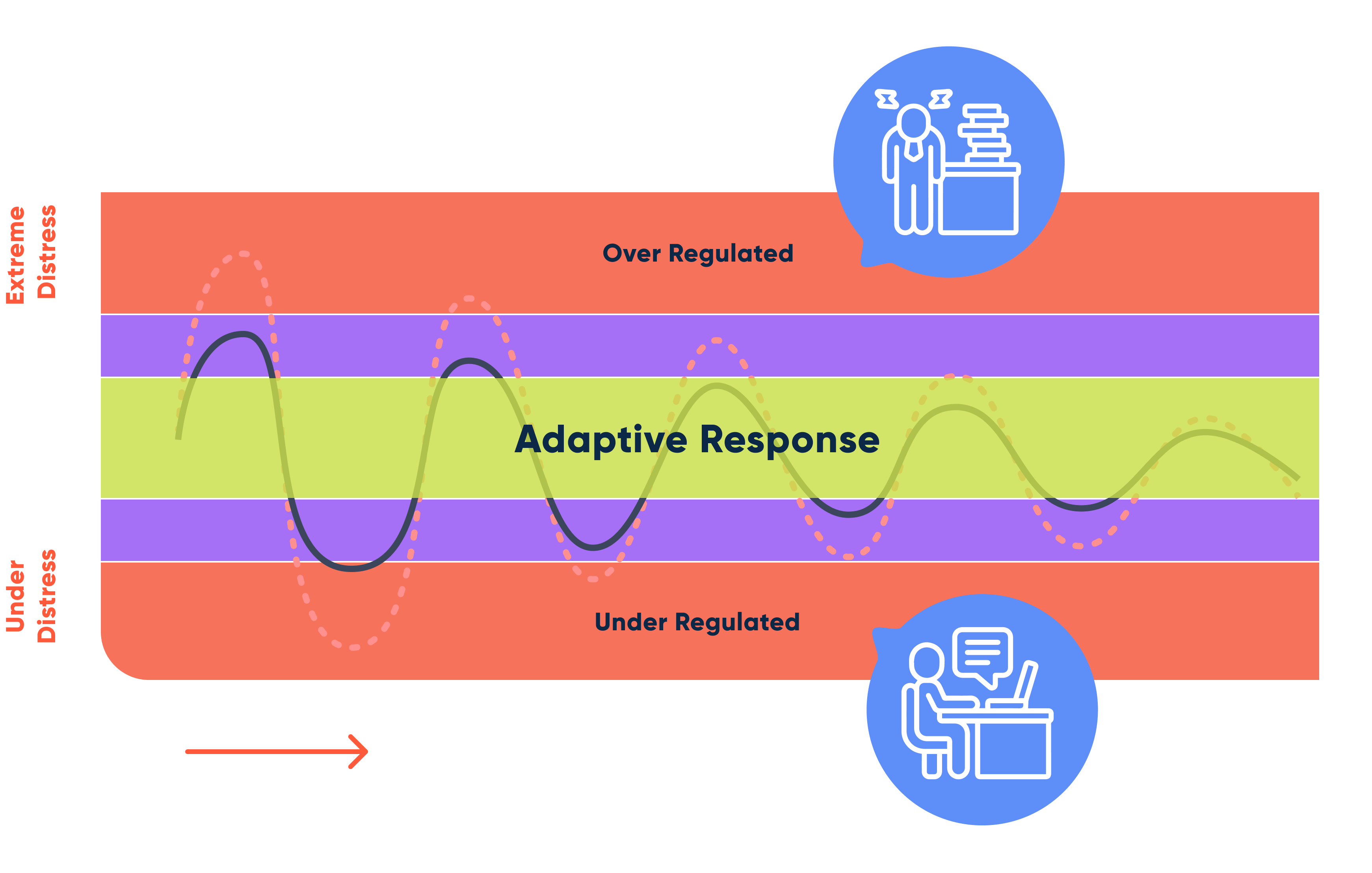
If left unmitigated, survivors, the community, and responders will find themselves in the Purple and Red zones of extreme distress. More adaptive actions by individuals and leadership will keep these groups in the Zone of Healthy Stress Regulation
Key Actions to Adaptive Mitigation of Stress
Survivors
Anticipation
Engage in actions to help channel anxious energy, such as calming thoughts, exercise, meditation and other spiritual practices
Impact
Share access to correct and credible information
Adaptation
Get involved in local projects that are planning for the post-disaster future
Growth & Recovery
Seek treatment for persistent mental health concerns
Community Leaders
Anticipation
Provision of anticipated needed resources
Impact
Promote actionable information from trusted resources
Adaptation
Build resources and resilience for middle and low income areas and high-risk subgroups and conduct planning to avoid returning to pre-disaster neglect
Growth & Recovery
Address competition and resentment between subgroups that has persisted or evolved
Responders
Anticipation
Address existing or anticipated compassion fatigue and burnout
Impact
Address responders’ needs to keep own families safe by offering co-sheltering and shared resources
Adaptation
Enlist disaster mental health experts to support responders at risk of burnout
Growth & Recovery
Monitor and seek help for consistent and severe stress/distress
Community Stress Load Threshold
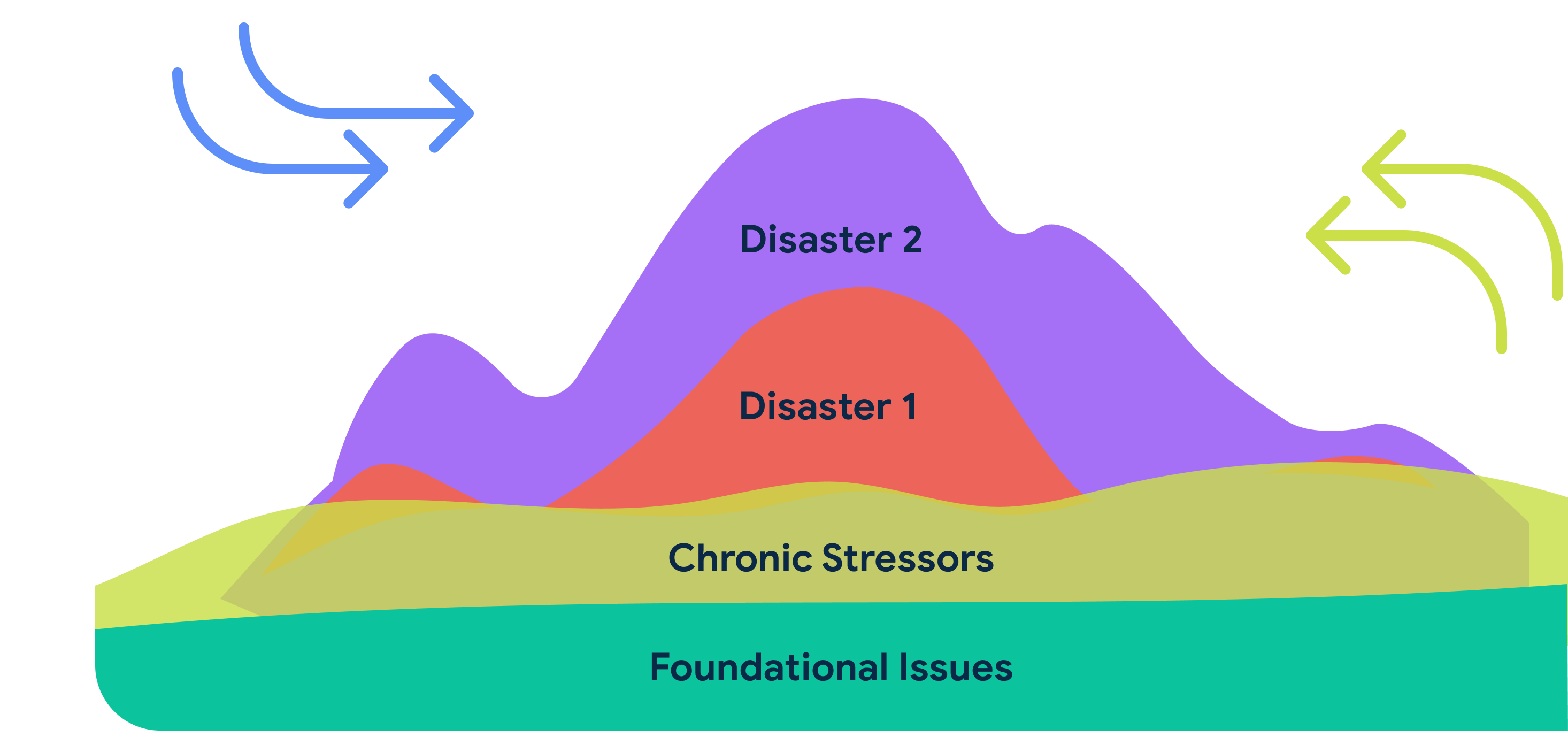
A country or community’s capacity to absorb the shock of a chronic disaster, such as a pandemic or war, depends on the foundational issues and stressors already present. It can be difficult to recover on its own when a community accumulates stressors that bring it to a tolerance limit.
Measure the Cumulative Stress Load in a Community
-
Acute Stressors
Health, economic, and environmental crises; police-community conflicts (Disaster 1 & 2) -
Chronic Stressors
Community violence, war, low income/resources, poor population health, housing instability, lack of political representation, and population loss -
Foundational Issues
Unemployment, low trust in institutions, intergenerational poverty, racism and discrimination as examples.Stakeholders can strengthen Protective Factors and address Imparing Factors to stay below the load threshold.
Mitigating the Cumulative Stress Load in a Community
- Anticipation
- Impact
- Adaptation
- Growth & Recovery
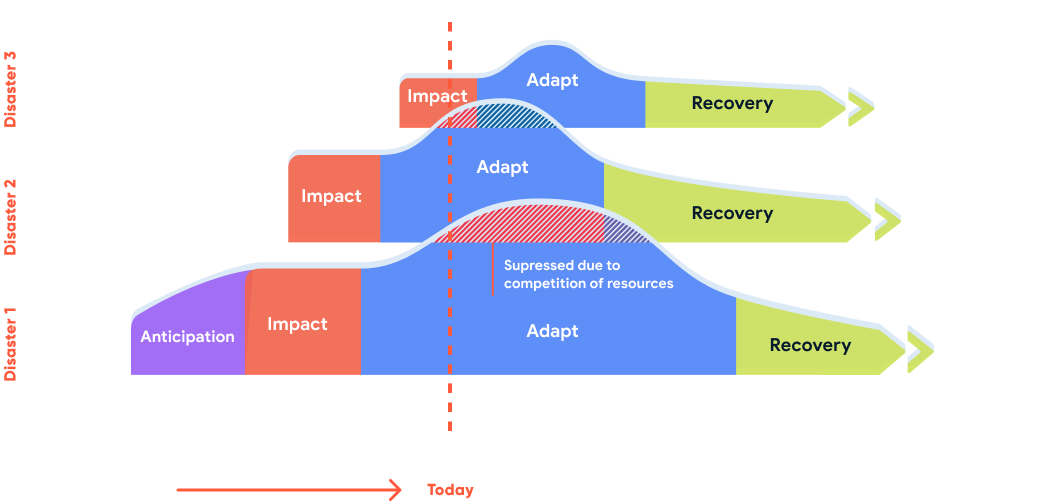
Community Balance Sheet
Communities may have ongoing disasters that can result in decreased resources. When survivors, responders and other community members work together, within each phase, these overlaid crises can be decreased to improve the community’s ability to problem solve and recover.
The potential negative effects of Stressors are more threatening if substantial Foundational Issues are already present in the community or country. Higher-risk subgroups have at baseline, higher levels of accumulated stress, which is worsened by an already thick layer of Foundational Issues. Higher-risk communities, cultures and subgroups may benefit from extra support from external resources to reinforce their response capacity. Communities that can address impairing factors and strengthen protective factors can decrease their cumulative stress load and may find their community ultimately strengthened.
About
This Model for Adaptive Response to Complex Cyclical Disasters (© 2022) was developed out of a three-way collaboration between Vibrant Emotional Health’s Crisis Emotional Care Team, the Group for the Advancement of Psychiatry’s Committee on Disasters, Trauma and Global Health, and Decision Point Systems.
Precipitated by the chronic, recurring disaster of the COVID19 pandemic, and superimposed natural disasters, forest fires and mass casualty events, we saw a pressing need to develop a framework for key stakeholders to make sense of and stage responses to the increasingly frequent and complex array of disaster events we face in contemporary society, superimposed atop chronic psychosocial and socioeconomic stressors.
The following infographic addresses several key topics, including:
- Revised “Phases of Disaster”, from Anticipation, to Impact, Adaptation, and Growth & Recovery
- Stress Regulation Model, highlighting key drivers of resilient and less adaptive response paths
- Focus on key stakeholder groups, including Survivors, Community Leaders and Responders, and specific expert guidelines for adaptive responses
- A model of Community Stress Load which incorporates the impact of Foundational Issues, Chronic Stressors and specific Disasters
- The “Community Balance Sheet”, a useful tool for specific communities to conceptualize and account for multiple, overlapping stressors in planning for all Stages of Disaster
Creators
Original downloads
Published language editions from MARCCD.info.